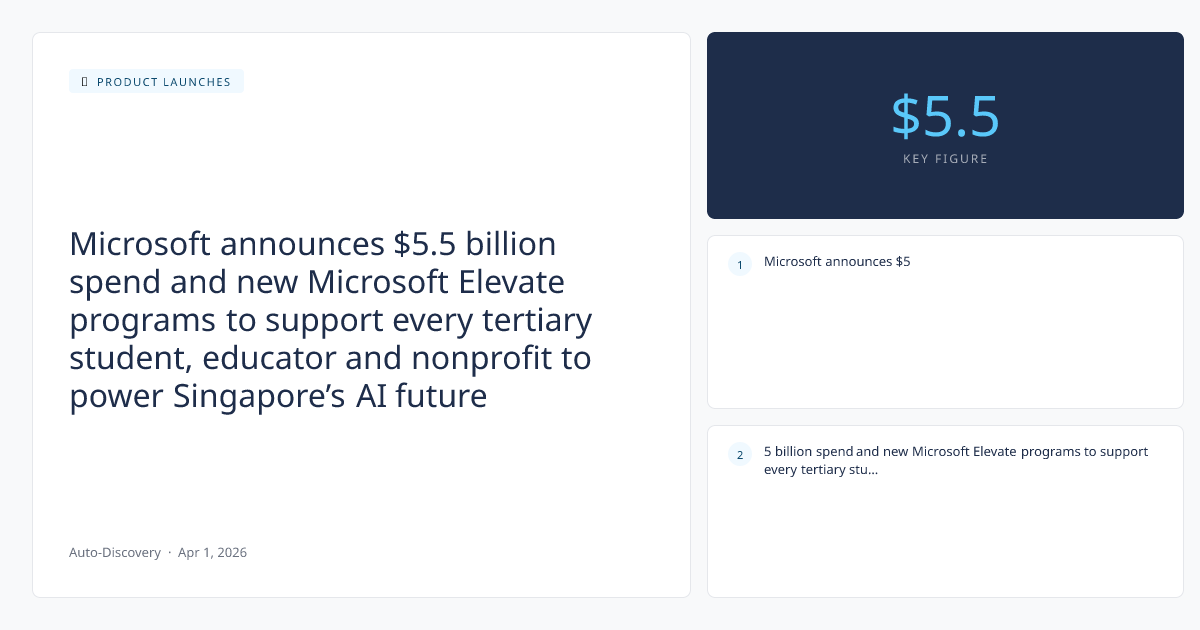
Microsoft announces $5.5 billion spend and new Microsoft Elevate programs to support every tertiary student, educator and nonprofit to power Singapore’s AI future
Key Takeaways
- •Microsoft's significant investment in Singapore, targeting every tertiary student and educator, highlights the urgent global trend of national strategies prioritizing widespread AI literacy and skill development through public-private partnerships.
- •This initiative provides a vital blueprint for integrating AI competencies directly into education systems, empowering educators to adapt curricula and equipping students with crucial future-ready skills.
- •The practical implication for other nations is the demonstration of how large-scale, strategic corporate-educational alliances can accelerate a country's readiness for the AI-driven economy.
Microsoft announces $5.5 billion spend and new Microsoft Elevate programs to support every tertiary student, educator and nonprofit to power Singapore’s AI future Microsoft Source
Our Take
Microsoft's significant investment in Singapore, targeting every tertiary student and educator, highlights the urgent global trend of national strategies prioritizing widespread AI literacy and skill development through public-private partnerships. This initiative provides a vital blueprint for integrating AI competencies directly into education systems, empowering educators to adapt curricula and equipping students with crucial future-ready skills. The practical implication for other nations is the demonstration of how large-scale, strategic corporate-educational alliances can accelerate a country's readiness for the AI-driven economy.
Topics & Tags
Analysis & Perspectives
Strategic Planning for AI Professional Development: Equipping Educators to Integrate AI as a Pedagogical Partner, Not Just a Tool
This article outlines a strategic framework for professional development, empowering educators to effectively integrate AI into their teaching practices. It moves beyond viewing AI as a mere tool, instead focusing on equipping educators to leverage AI as a sophisticated pedagogical partner. The aim is to enhance learning experiences and foster innovative instructional design.
Redefining Assessment and Feedback Strategies in the Age of Generative AI: From Plagiarism Detection to Promoting Critical AI Literacy
This article explores how the advent of generative AI necessitates a fundamental re-evaluation of assessment and feedback strategies in education. It advocates for a shift from solely focusing on plagiarism detection towards cultivating critical AI literacy among students. The piece outlines innovative approaches to integrate AI responsibly, ensuring academic integrity while equipping learners with essential skills for an AI-driven world.
People Also Ask
What AI products has Microsoft recently released for education?▾
How is Microsoft using AI in schools?▾
Is Microsoft Copilot available for students and teachers?▾
What is Microsoft's stance on AI and academic integrity?▾
Related Articles
ClearSteps Launches as India's First End-to-End AI-Powered CBSE Exam Preparation Platform
ClearSteps Launches as India's First End-to-End AI-Powered CBSE Exam Preparation Platform openPR.com
How AI is Transforming Tutor App Development in the Education Industry?
How AI is Transforming Tutor App Development in the Education Industry? nerdbot
ClearSteps Launches as India's First End-to-End AI-Powered CBSE Exam Preparation Platform
ClearSteps Launches as India's First End-to-End AI-Powered CBSE Exam Preparation Platform openPR.com